About me

I am a postdoctoral researcher at MIRALab, University of Geneva, working with Prof. Nadia Magnenat-Thalmann. My research connects learning, reasoning, and human interaction.

As a scientist, I am passionate about solving problems and connecting ideas across disciplines. My research philosophy is grounded in interdisciplinarity, adaptability, and openness to ideas that can lead to novel approaches. Throughout my academic career, I have worked across knowledge representation, neuro-symbolic AI, machine learning, explainable AI, robotics, computer vision, multimodal learning, and generative AI.

This breadth shapes my research by connecting methods across fields to build AI that learns from limited and evolving data, incorporates knowledge, and remains understandable to people. Currently, I develop methods and AI systems for cultural heritage analysis and reconstruction, and contribute to social robotics and AI-assisted surgical training. My earlier work explored how models learn and explain evolving social concepts in online communities.

Google Scholar

thiago [dot] freitasdossantos [at] unige [dot] ch

Academic Experience

  • Postdoctoral Researcher in AI

    MIRALab, University of Geneva, 2024–present

    Switzerland

  • Visiting PhD Researcher

    University of Otago, 2022

    New Zealand

  • Summer Research Student

    University of Galway, 2015

    Ireland

    CAPES scholarship

  • Undergraduate Researcher

    University Center of FEI, 2012–2014

    Brazil

    CNPQ research funding

Industry Experience

  • System Analyst

    Everis, 2019

    Brazil

  • Web Developer · Technical Leader

    Cognizant, 2016–2017

    Brazil

  • Web Developer

    Class Solutions, 2015–2016

    Brazil

  • Web Developer Intern

    Animatech, 2012

    Brazil

Education

  • PhD in Artificial Intelligence, 2020–2024

    Autonomous University of Barcelona

    Cum Laude

  • MSc in Artificial Intelligence, 2017–2019

    University Center of FEI

    FAPESP scholarship

  • BSc in Computer Science, 2011–2016

    University Center of FEI

    Honours · First in class · PROUNI scholarship

  • Computer Science exchange programme, 2014–2015

    University of Galway

    CAPES scholarship

Thiago Freitas dos Santos, Nadia Magnenat-Thalmann

Under review2026

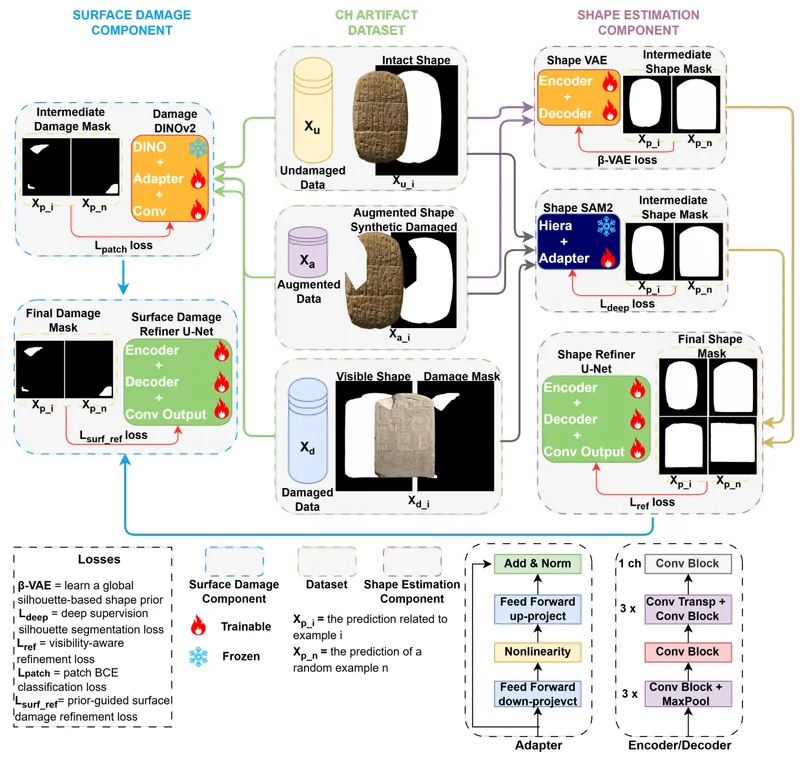
Preserve my Heritage: A Shape-Informed Neural Framework for Damage Analysis and Segmentation in Cultural Artifacts

Introduces DASCH-Net, a shape-informed neural framework for analyzing damage in cultural artifacts. Combines intact-shape estimation, surface-damage segmentation and interpretability to support cultural heritage preservation.

Le Ma, Thiago Freitas dos Santos, Nadia Magnenat-Thalmann, Katarzyna Wac

2026IEEE/CVF Conference on Computer Vision and Pattern Recognition (CVPR)

SHands: A Multi-View Dataset and Benchmark for Surgical Hand-Gesture and Error Recognition Toward Medical Training

Introduces a multi-view video dataset and benchmarks for recognizing surgical gestures and trainee errors. Supports research on automated skill assessment and recognition across different camera viewpoints in medical training.

Thiago Freitas dos Santos, Stephen Cranefield, Bastin Tony Roy Savarimuthu, Nardine Osman, Marco Schorlemmer

2023International Joint Conference on Artificial Intelligence (IJCAI)

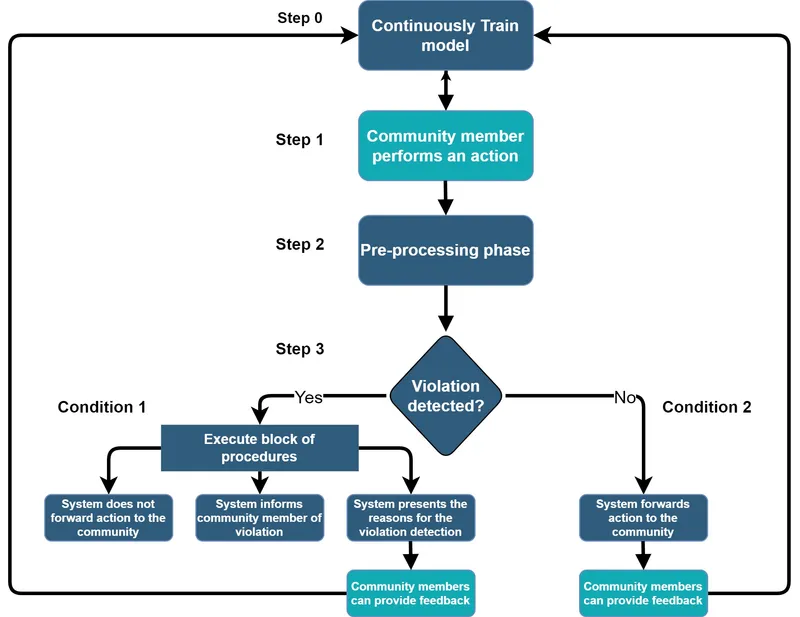
Cross-community Adapter Learning (CAL) to Understand the Evolving Meanings of Norm Violation

Transfers knowledge between online communities through adapters in transformer-based language models. Uses explanations to examine community-specific meanings of norm violations and improve learning when target-community data are limited.

Thiago Freitas dos Santos, Nardine Osman, Marco Schorlemmer

202221st International Conference on Autonomous Agents and Multiagent Systems (AAMAS)

Ensemble and Incremental Learning for Norm Violation Detection

Uses an ensemble of incrementally updated classifiers to learn what a community considers a norm violation. Addresses imbalanced interaction streams and concept drift, with evaluation on Wikipedia vandalism detection.

Thiago Freitas dos Santos, Danilo Gouveia de Castro, Andrey Araujo Masiero, Plinio Thomaz Aquino Junior

2014Human-Computer Interaction. Advanced Interaction Modalities and Techniques (HCI 2014)

Behavioral Persona for Human-Robot Interaction: A Study Based on Pet Robot

Develops behavioral personas to guide human–robot interaction design. Uses a pet-robot study to connect user characteristics with the design of robot interactions.

Postdoctoral research

DASCH-Net

Shape-informed damage analysis for cultural heritage artifacts, combining intact-shape estimation, surface-damage segmentation, and interpretability.

Postdoctoral research

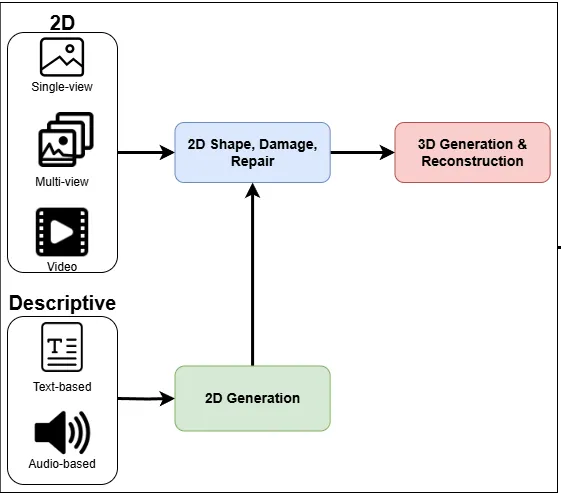
AI APIs for cultural heritage

AI services developed for ENIGMA, an EU project safeguarding cultural heritage. The APIs connect multimodal input, artifact restoration, single-image 3D generation and multi-view reconstruction to the project’s platform and services.

My academic path has taken me across Brazil, Ireland, Spain, New Zealand, and Switzerland. I speak Portuguese, English, Spanish, and French, and enjoy connecting ideas across disciplines.

My interest in human–robot interaction began with Sony AIBO during my undergraduate research. Watch my gesture-based AIBO control demonstration.